Saturday, 28 January 2017

Hell or High Water - Review


Granted, this is a film that came out a while back, but seeing as it’s in award contention, let’s roll with it. David Mackenzie follows up his gritty prison drama Starred Up by taking the man with the truest grit and placing him in yet another western. Only this time he’s after Captain Kirk and the guy from 3:10 to Yuma.
The True Grit isn’t purely because Jeff Bridges is a lawman in that western and Hell or High Water; ‘The Dude’ casually channels the same grumbling,  dry performance as Texas Ranger Marcus Hamilton. It’s not quite as lazy as it sounds, largely because of a particularity heart-prodding scene where the tough, cheerful exterior cracks (albeit briefly) under intense emotional pressure. It also helps Bridges is so goddamn charming.
Toby and Tanner Howard (Chris Pine and Ben Foster respectively) are two brothers desperately robbing banks to stop the bank from foreclosing on their farm. While Toby is reluctant, ex-con Tanner is the wildcard enjoying the thrill of the crime. Foster – despite his character’s misgivings – is delightfully watchable in these instances, whereas Pine excels in the quieter moments where Toby gravely faces down the slimy bank manager. The duo are typically sympathetic, with their honourable cause, but the backstory and personality clashes are what flesh them out into more than just simple Robin Hood-ish figures.
The strengths of the ‘stick-it-to-the-man’ story lie in the characters. Sadly, Taylor Sheridan’s script does lay the point on a bit to thick in places, especially when Marcus’ partner Alberto (Gil Birmingham) compares the banks to invading settlers who screwed over his ancestors. Then again, that hardly makes the point less valid.
Like many of the best thrillers, Mackenzie doesn’t inject Hell or High Water with unnecessary action sequences or western staple shootouts. That may turn some action aficionados, but when the final confrontation arrives, it has over an hour of dramatic tension and build up to support it.
FOUR STARS – Very solid and lean, but seriously if you haven’t seen Starred Up, do it. It’s got Jack O’Connell’s balls in it and everything.

Sunday, 22 January 2017

Manchester By The Sea - Review


The word ‘understated’ is thrown around a lot to label anything that isn’t overly melodramatic or straightforward, but the performances on display here go beyond down-to-Earth realism. It feels obvious and almost hackneyed to say “Oh aren’t they believable”, but Casey Affleck and co are astonishingly so.
Kenneth Lonergan’s third film as director demonstrates his theatrical background with Manchester By The Sea  with restraint. The focus is very much on character and performance, but that isn’t to say that’s all the film has going for it; a relatively simple story is told with an effectively fractured narrative, gradually releasing more heartbreaking backstory about Lee Chandler (Affleck). The plot centres around Lee’s brother Joe Chandler (Kyle Chandler, confusingly) dying unexpectedly, leaving his son Patrick (Moonrise Kingdom’s Lucas Hedges making his breakout role) in his care. The hard-drinking, morose Lee is forced to revisit his hometown and associated strife, including the event that sent him into self-exile and his equally tortured ex-wife Randi. Michelle Williams shines as Randi despite limited screen time, especially in the present day scenes. Consequently, an Oscar win may just be out of reach.
Affleck has a much stronger chance. After years of inconsistency and personal issues dogging his career, Batman-the-younger may finally slip firmly into the A-list with his tortured turn in the film. Every line is imbued with sorrow, and the false starts and pauses as he tries to communicate his feelings make Lee an immediately relatable character. Moreover, the overarching themes of grief and death won’t fail to resonate with anyone whose lost someone. Or in Patrick’s case, been uprooted from their life. If there’s any justice, Hedges’ quietly distraught teen will received award attention from The Academy – over fumbling, limited Hugh Grant –  where the BAFTAs and Globes didn’t.
The strength that sets Manchester apart from pieces of Oscar bait and tragedy-filled dramas is in the trivial and sardonic details. A central piece of emotional release is triggered by a mundane freezer snafu in the kitchen. Chunks of the film are devoted to funeral planning, logistics surrounding Lee’s potential move and boat motors. Lonergan truly places a mirror up to real life without embellishing.
FIVE STARS. Seriously though why has Hugh Grant done so well this year?

Friday, 13 January 2017

La La Land - Review


Straight from the outset, we’re in old-fashioned territory. Cinemascope, roman numerals and a title-card reminiscent of Singin’ In The Rain. After presenting a cruel world of musical ambition in Whiplash, Damien Chazelle crafts a love letter to ambition, delivered in a musical envelope. What he posts to us is effortlessly cool, and stunningly infectious.
Sebastian (Ryan Gosling) and Mia (Emma Stone) meet in the beautifully coloured LA with aspirations to be a jazz club owner and an actress, respectively. After a few “curt” encounters – which include the amusing sight of serious pianist Sebastian having to make ends meet in an 80s tribute band- the two begin to see each other and encourage their career pursuits. The two loveable leads have such chemistry that every scene feels genuine after collaborating on Crazy, Stupid Love and Gangster Squad, be it a romantic interlude of a blazing row. They also bring something rarely seen these days: the triple threat. Despite being Gosling being a novice pianist before production and the duo having to learn to sing and dance, Stone and Gosling have a clear Fred Astaire and Ginger Rogers quality that will undoubtedly be iconic in years to come, and at the very least earn them Oscar nominations.
Choreographer Mandy Moore and composer Justin Jurwitz deserve equal credit to Chazelle’s vibrant direction, for without the captivating dancing of a dozen extras in a traffic jam set to the insanely catchy ‘Another Day In the Sun’, the opening set piece wouldn’t have anywhere near the impact. The same can be said about every musical piece, however. The glorious, theme-setting intro isn’t topped by any of the following (also superb) songs or dances, but the poster shot of Gosling and Stone tap-dancing overlooking LA comes close.
Optimistic idealism in a sun-kissed land of fame and artistic glory would be foolhardy, if Chazelle didn’t undercut it with necessary realism. Things don’t always work out, but no film will subconsciously control your feet, heart and facial muscles as much as La La Land; it will contort your cynical mouth into a giddy smile with its ubiquitous fun.
A WHOLEHEARTED FIVE STARS. – Luke.

Wednesday, 11 January 2017

Nine Lives - Review


It took five screenwriters to create this. Not so much too many cooks spoiling the broth, but pissing in it and pinning you down as they pour it down your throat. Not one single gag lands, be it Kevin Spacey having to eat cat food or him using his ex-wife’s handbag as a litter tray.
The plot you ask? A business man (double OSCAR WINNER Spacey) is turned into a cat to treat his wife (GOLDEN GLOBE WINNER Jennifer Garner) and daughter better. It’s as woefully predictable as you’d expect. Why Barry Sonnenfeld chose to direct this, and why the stars opted in, can be explained by one dollar-sign shaped reason. Shame on us for letting it make $14 million more than its budget.
Spacey phones it in to a shameful degree, clearing delivering every snarky line channeling his inner distaste for the film and regret. But OSCAR WINNER Christopher Walken almost makes it watchable as a kooky pet shop owner. His name: Perkins. The pun: Purrkins.
Gwyn Lurie. Matt R. Allen. Caleb Wilson. Daniel Antoniazzi. Ben Shiffrin. Remember these names as you plan your Arya Stark styled list of vengeance. Or when predicting this year’s Razzie for worst screenplay.
TWO STARS. Not giving it one star feels like an act of charity, but the so-bad-it’s-good factor’s presence is undeniable. 

Tuesday, 10 January 2017

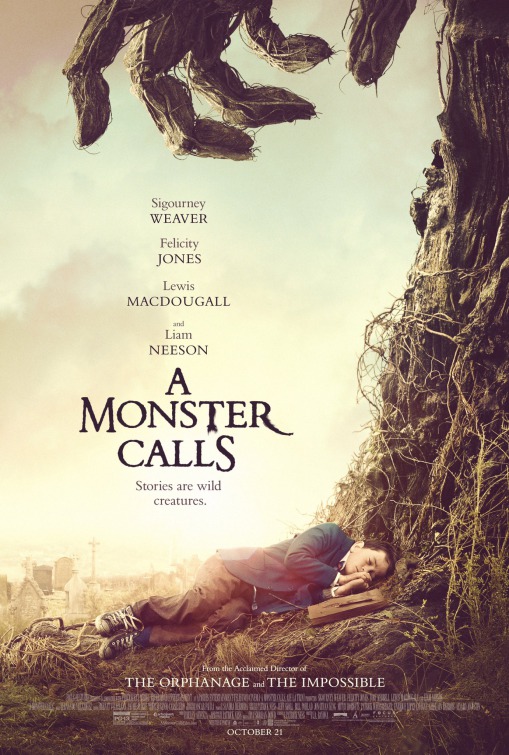
A Monster Calls – Review


If JA Bayona can helm the next Jurassic Park film with the perfect balance of spectacle and drama on display in A Monster Calls, then it’l be a vast improvement on Jurassic World, where plot and characters took the back seat as spectacle drove it towards mediocrity.
Anywho, here’s the adaptation of the fantasy-drama book of the same name, pitting young boy Conor against the hardships of his mother’s (Felicity Jones) cancer and an ancient tree creature determined to teach him a lesson through three beautifully animated fables. After the third, Conor must tell his own. 14 year-old Scot Lewis MacDougall does an astonishing job of a.) putting on an accent and b.) showcasing the tormented feelings as genuinely as any actor could whilst remaining childishly innocent, flicking between impatiently questioning the fables and unleashing alarmingly furious beatings on inanimate objects. He’s certainly a young one to watch.
Conor’s emotionally distant, strict Grandmother (Sigourney Weaver) and separated father (Toby Kebbell) offer him little help, but Weaver does offer a fine performance as he walls are broken down by her daughter’s condition and grandson’s destructive behaviour. Kebbell is nothing to shout about, but it’s nice to see him in something that isn’t god awful for a change, while Jones is given virtually nothing to do save for an impassioned and serviceable speech, enhanced by MacDougall’s reaction.
And of course, there’s The Monster. Armed with the sensual, dulcet tones of Liam Nesson, a message about grief and an effectively applied CGI budget, The Monster is extremely watchable without any of the charm of Groot. It’s intimidating and serious, but good lord can Neeson regale us with a well-told story within the story. The fantasy never overshadows the drama – or vice versa – so Conor’s journey is always centre stage, and it’s one that will undoubtedly resonate with most who see it.
By the end of the film, if your eye isn’t moistened by the impactful last shot, you are a stone cold bastard. Bear in mind this is coming from a stone cold bastard.
FOUR STARS – Luke’s just going to go tell his mum he loves her now.

Monday, 2 January 2017

Silence - Review


There’s nothing more satisfying than seeing a director’s long-gestating passion project arriving on screen, especially when it’s a Martin Scorsese film. However, with that level of anticipation and a hefty $50 million budget, Silence is under more pressure to perform than a Jesuit priest left hanging upside down for days.
While not to everyone’s taste thanks to the near crippling run-time and lack of non-diegetic sound, it makes for a (typically) well-crafted existential epic that rewards viewers with enough drama and meditative themes to occupy the brain for days.
Silence sees Andrew Garfield and Adam Driver search for their mentor as Fathers Rodrigues and Garrpe, 17th century Porteuguese priests in hostile Japan. Facing persecution and guilt regarding Japanese Christians punished for their presence, they fail to find Father Ferrara (Liam Neeson offering his finest work since Schindler) and instead find themselves questioning their blind faith in a voiceless God. “Am I just praying to silence?” Rodrigues asks. Scenes of cruel torture and humiliation wear away at the fugitive preachers, and Scorsese frequently visits the theme surrounding God’s apparent indifference towards those devoted to him without outright blasphemy or unrefined  angst that many may have channeled. The lack of a score for the majority of the film creates a natural environment, devoid of divine intervention even as Garfield passionately begs for validation.
Left to carry the weight of the film for a period, Garfield rises to the occasion as a man of the cloth whose faith is as tortured as the Christians are physically by the Japanese (who thankfully aren’t completely vilified, their point of view is justly examined), shown through his layered performance, exhibiting grief, anger and mania as he dominates the screen. Any one of the supporting cast could be in awards contention, be it Driver’s increasingly skeptical and pessimistic Garrpe – who Driver ending up losing 50 lbs for the role – or cowardly Kichijro, ably played by Yosuke Kubozuka; Kubozuka carries the weight of his character’s past misdeeds with pained facial expressions and the appropriate gravitas. The standout is probably Issei Ogata’s antagonistic menace Inoue. His thoughtful conversing with Rodrigues, laden with metaphors for the inability for Christianity to translate in Japan best surmises the overarching themes.
Silence is at its best when depicting Garfield’s pride-infused beliefs being shattered. Once the early consequences of the duo’s mission become painfully abundant, the film breaks out of its trudging walk into a spectacular jog through gorgeously filmed locations and ideal cinematography (kudos to Rodrigo Pietro for capturing the haunting image of the Inquisition emerging from steam and mist). It refuses to pull punches in its authenticity or delivery of its purpose.
Little more could be expected from the New York director or such rich material.
FOUR STARS and a respectful bow for a mammoth task.